


Hexa Sort Strategy for Hexa Nest
Updated 5 min read
Quick answer
In Hexa Nest, a hexa sort puzzle, you drag stacks of coloured egg tiles onto a honeycomb. Stacks with the same top colour next to each other merge tile by tile, and 10 or more of one colour on top hatch into an OvO. The core strategy is to drop each stack where it touches several matching tops, keep the central cells free and plan for the colour underneath.
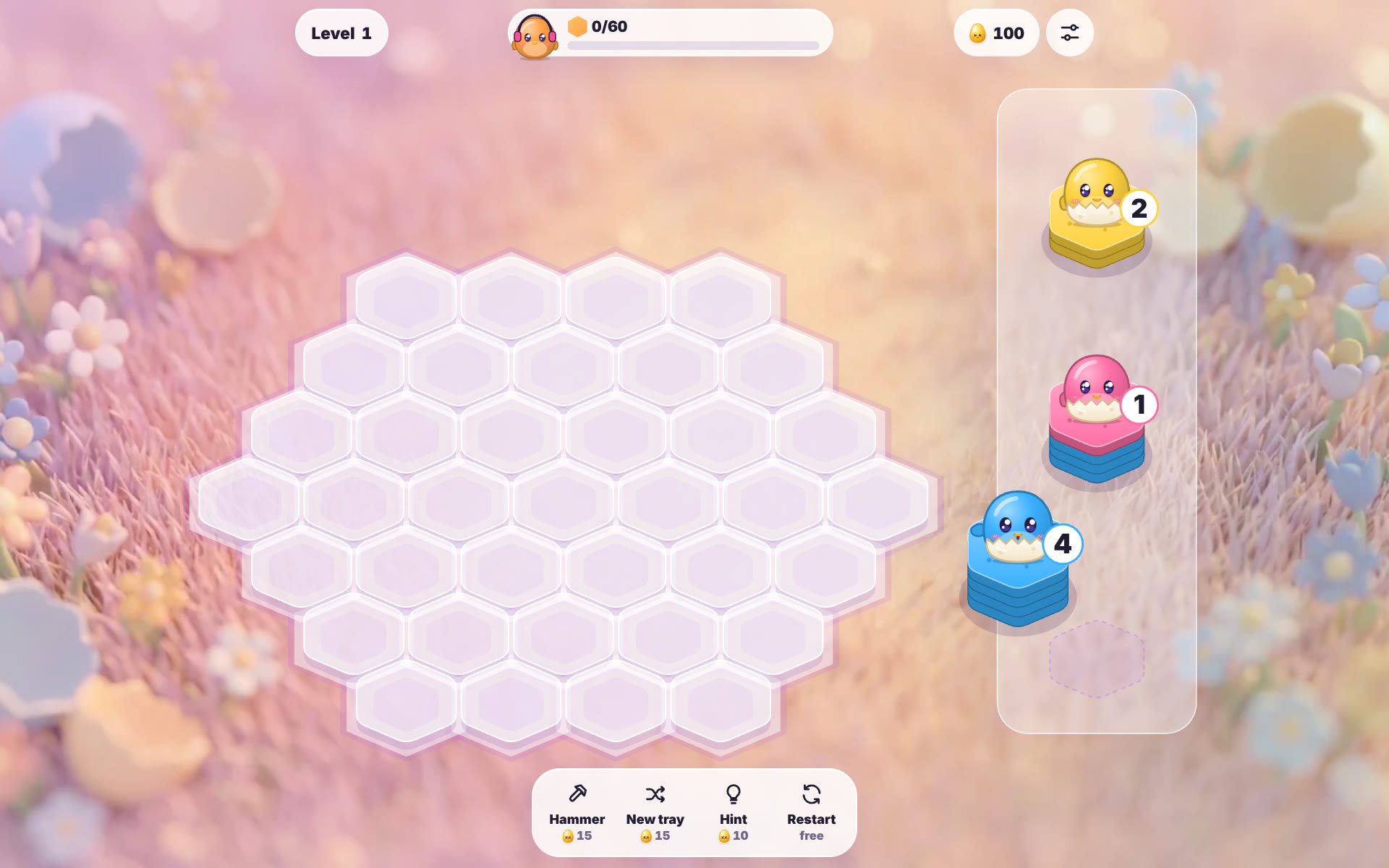
Hexa Nest is the OvO take on hexa sort. Tiles flow across the board in little arcs, and one good placement can set off a chain reaction. Every cell has up to six neighbours, so where you put a stack matters more than anything else. This guide explains how merging decides where tiles go, then gives you a plan for keeping the honeycomb under control on harder levels.
On this page
How does Hexa Nest work?
Each level gives you a goal, such as hatching 60 tiles on level 1, and the board fills up as you play.
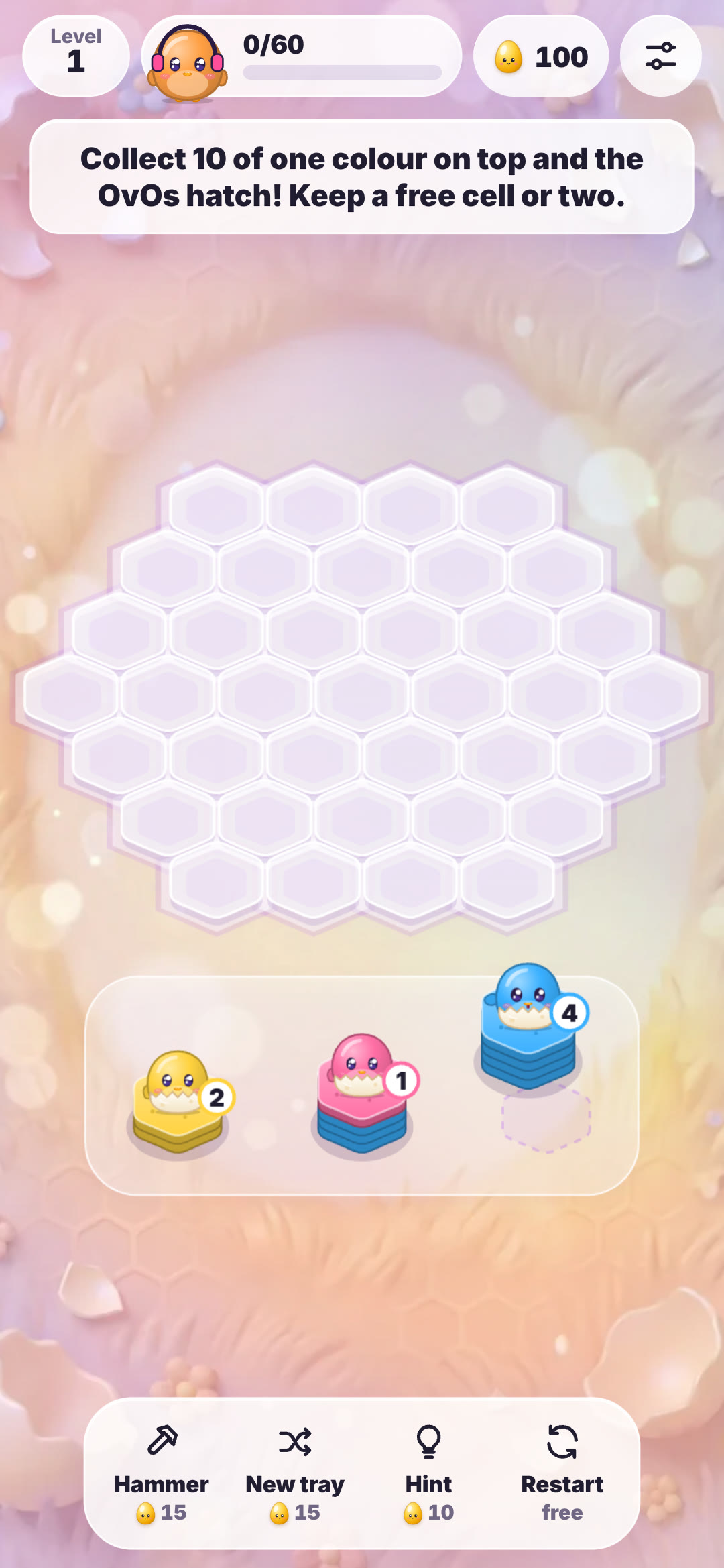 Step 1: Look at the tray. It offers three stacks of 2 to 8 tiles, each with up to three colour groups. Only the top group counts for merging, and the number badge shows how many tiles of that colour sit on top.
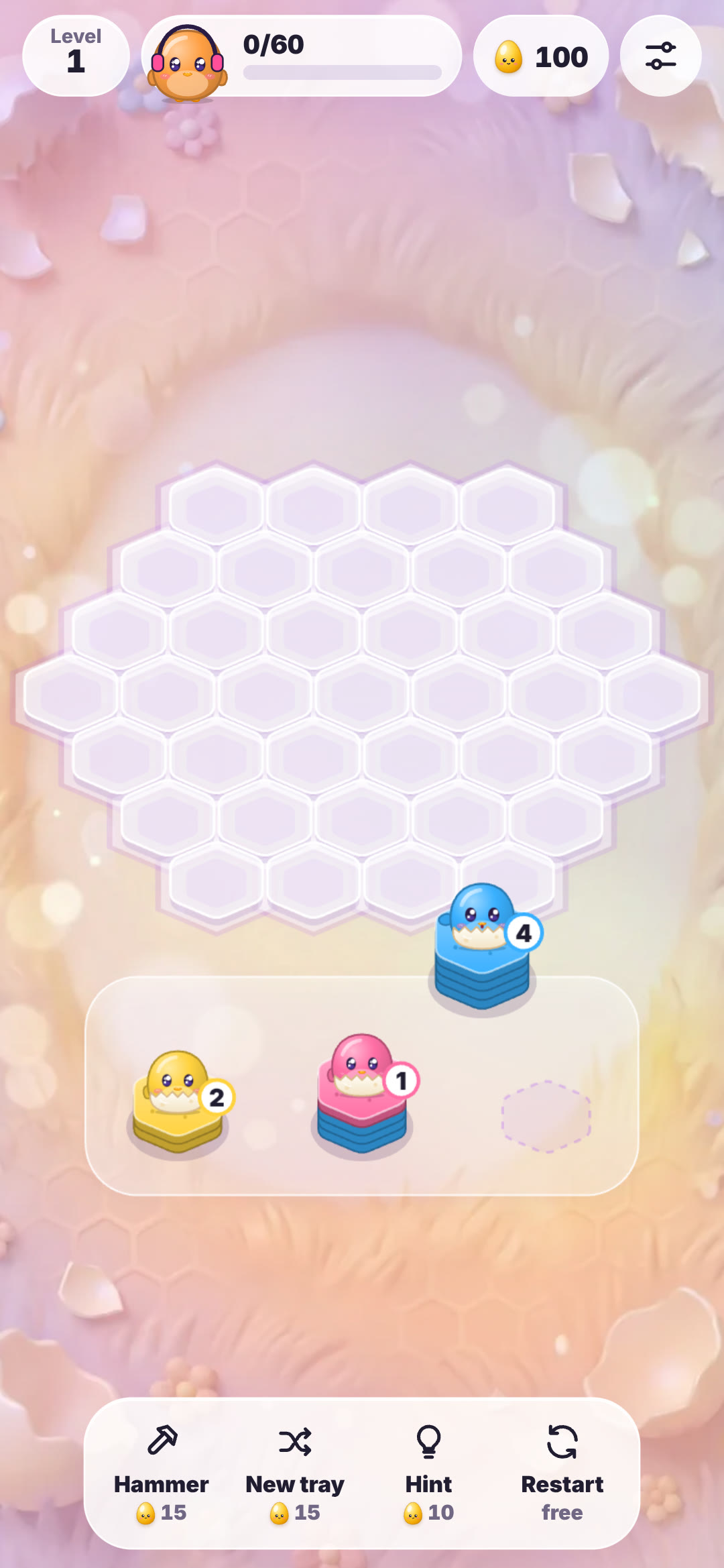 Step 2: Drag a stack onto an empty cell. The pile is drawn just above your finger so you can still see it, and it lands on the cell underneath. Tap a stack and then a cell if you prefer tapping.
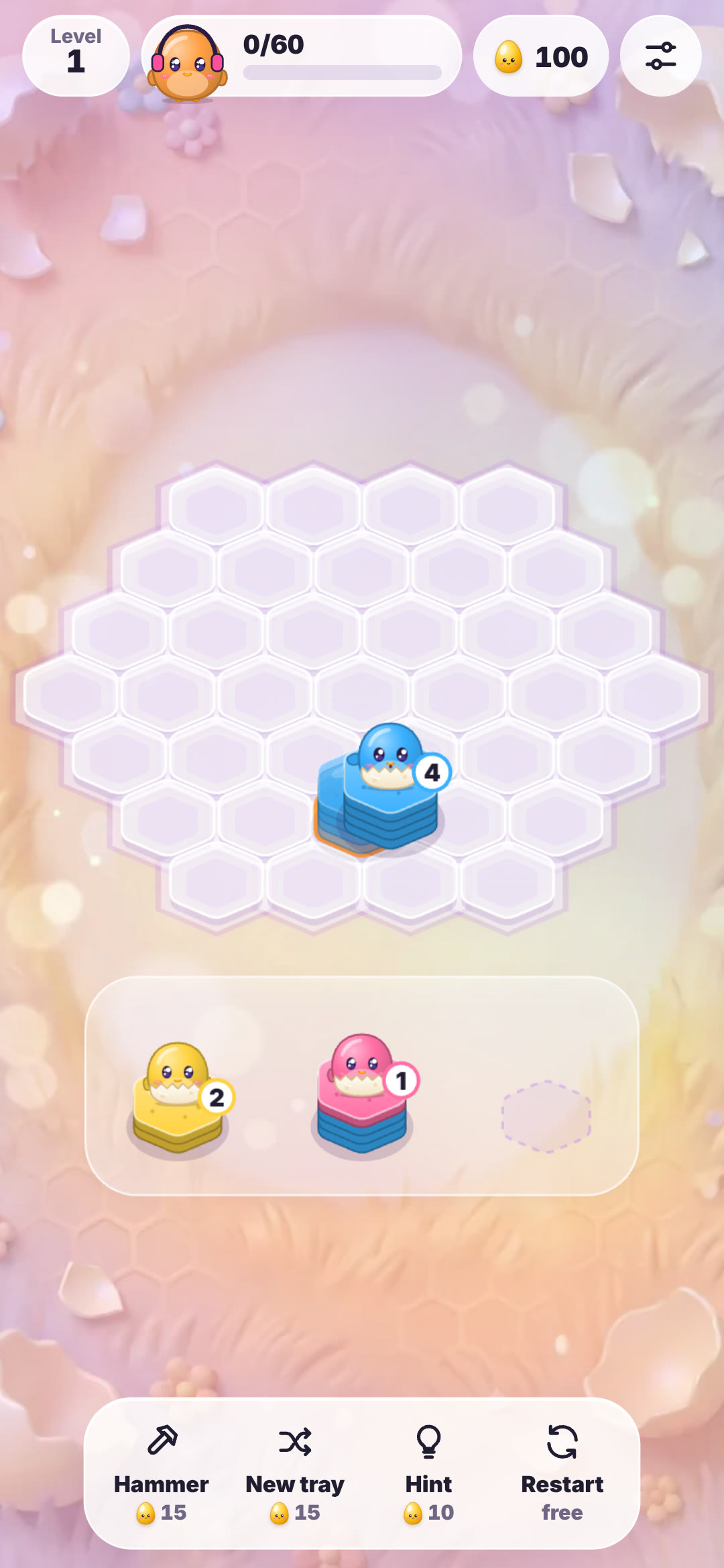 Step 3: Check the highlighted cell before letting go. When neighbours share the top colour, tiles flow over one by one. Ten or more of one colour on top hatch into an OvO that flies to the goal counter. Once all three tray stacks are used, three new ones are dealt.
Where should you place each stack?
Aim for cells that touch two or more stacks with the same top colour as the one you are holding. A stack that touches several matching neighbours becomes the hub and pulls all of them in, smallest first, so the colour ends up in one tall pile. That is the quickest way to reach 10 and hatch. With only one matching neighbour, the game moves tiles in the direction that exposes another match where possible, which is how chains start. If no cell has a match, put the stack next to stacks whose lower layers share its colour, so it becomes useful after a merge or two. Combos matter for score as well: two or more flows from one move show Combo x2 and up, and your best combo adds to the level score.
Why keep the middle of the board open?
Central cells have the most neighbours, so they are the cells that start the biggest chains. Filling them early with mixed stacks that match nothing is a common way to lose, because you only lose when no empty cell is left after a move. Use the edges and corners for awkward stacks instead. A corner cell blocks fewer neighbours, and as colours line up later you can work those stacks back into play. Watch the warning signs too: with two or fewer free cells the empty cells pulse red and Coach OvO starts to worry. Free cells left at the end also add to your score, so a tidy board pays twice.
How do you plan for the colour underneath?
Most stacks hold more than one colour. When the top group flows away, the next colour is revealed and may match a different neighbour, and the game checks every changed stack again. Strong players look one layer deeper before each drop. If a pink top sits on blue tiles, place it so the pink merges away and the blue lands next to another blue top. Two or three of these planned reveals in a row give long chains on purpose instead of by luck. The tray deals come from a fixed sequence for each level, so a level you replay will offer the same stacks in the same order, and you can try a better plan.
What changes on harder levels?
Hexa Nest has 200 levels. New ideas arrive gradually. Twig nests shape the board from level 6 and can never be used. Padlocked cells appear from level 14 and show how many more tiles must hatch before they open, so count down and plan for the new space. Sleepy stacks marked with z z arrive from level 22 and refuse to merge until a neighbour hatches. From level 20, about every third level asks for two colour goals, such as a number of pink and a number of yellow tiles, so feed those colours first. Board shapes also change between hexagon, round, heart and other forms, which moves the cells with the most neighbours. Every fifth level is a breather and every tenth level is hard.
Which boosters help most, and where can you play?
Hammer smashes one stack you tap, which is ideal for a mixed stack stuck in the middle. New tray swaps the stacks in your tray for three set new ones, and one of them always fits a match. Hint makes the best placement glow, and it is a good teacher for multi-neighbour moves while you learn. Continue clears the three tallest stacks when you run out of room. Hexa Nest is free in your browser at ovo.games and in the OvO Games app for iOS and Android. The first 40 levels are free with ads, and OvO Pass unlocks all levels and removes ads.
| Mechanic | From level | What it does | How to play it |
|---|---|---|---|
| Twig nests | 6 | Fixed cells that can never hold a stack | Re-read which cells have the most open neighbours |
| Padlocked cells | 14 (two from 61) | Open after a set number of hatched tiles | Watch the counter and plan to use the new cell |
| Colour goals | 20 | Ask for a number of tiles in two colours | Hatch the goal colours first |
| Sleepy stacks | 22 (two from 91) | Do not merge until a neighbour hatches | Hatch a stack next to them to wake them |
| Breather levels | Every 5th | One colour fewer, more cells, simpler stacks | Practise building long chains |
| Hard levels | Every 10th | One colour more, fewer cells, more mixed stacks | Keep the middle free and use Hint early |
Watch
Hexa Nest gameplay
Egg-tile stacks dragged onto the honeycomb, merging tile by tile and hatching OvOs.
▶ 28 sec
Questions
How many tiles do you need to hatch an OvO in Hexa Nest?
Ten or more tiles of one colour on top of a stack hatch into an OvO, which flies to your goal counter.
When do stacks merge in hexa sort?
When neighbouring stacks share the same top colour. The tiles flow across one by one, and every stack whose top changes is checked again, which can start a chain.
How do you lose a level?
You lose when no empty cell is left after a move. A Continue clears the three tallest stacks so you can keep going.
What are sleepy stacks?
Pre-placed stacks marked with z z that do not merge until a neighbouring stack hatches. They appear from level 22.
Is Hexa Nest free?
Yes. Levels 1 to 40 are free for everyone with ads, in the browser and in the app. OvO Pass unlocks all 200 levels and removes ads.
 Chick Sort
 Screw Crew
 Nest Blocks
 Nest Express